Azahari Hassim
The Prophet said:
فَإِنَّ اللَّهَ عَزَّ وَجَلَّ تَوَكَّلَ لِي بِالشَّامِ وَأَهْلِهِ.
Allah, the Almighty, has entrusted the Sham and its people to me.
(Hadith Musnad Imam Ahmad).
Some believe the above hadith is related to establishment of Islamic caliphate in the region of the Sham (الشَّامِ). They point to the Arabic word “تَوَكَّلَ”. What is the definition of “Sham”? How is their argument articulated?
Definition of “Sham” (الشَّامِ):
It is an Arabic term historically used to refer to the region commonly known today as the Levant. This region encompasses several modern-day countries, including:
Syria
Lebanon
Jordan
Palestine
Israel
It is a region with significant historical, religious, and cultural relevance within the Islamic tradition and also in the broader Middle Eastern history.
Articulation of the Argument:
Supporters of the view that the hadith relates to the establishment of an Islamic caliphate in the region of Sham argue their case as follows:
1. Divine Mandate:
The verb تَوَكَّلَ means to entrust, rely upon, or delegate responsibility to someone. When used in this hadith, it implies that Allah has entrusted or vested a particular responsibility to the Prophet Muhammad regarding the region of Sham and its people.
2. Vision of Governance:
By declaring that “Allah has entrusted me with Sham and its people,” the Prophet may be indicating a divine endorsement for governance or leadership over this region. This is seen as a sign that the area holds special significance and is destined for a particular kind of leadership.
- Historical and Religious Importance:
Sham holds a crucial place in Islamic history and eschatology. It was a major center of early Islamic civilization and later became a vital part of various Islamic caliphates, including the Umayyad Caliphate, which had its capital in Damascus.
- Connotation of تَوَكَّلَ:
The word تَوَكَّلَ does not just convey a simple trusting; it suggests a deep and complete reliance and entrustment. This profound sense of divine trust can be seen as an indication of a significant leadership role for the Islamic community in that region.
- Legacy of the Prophet’s Teachings:
The fact that the Prophet Muhammad would mention that Allah entrusted him with Sham can be interpreted as a directive for his followers to see this region as a central area for Islamic governance and societal development.
Key Points in Their Argument:
Linguistic Interpretation:
Emphasis on the word تَوَكَّلَ (entrusted) as an indicator of divine delegation and responsibility.
Geopolitical Importance: Recognition of Sham as a historically and religiously significant region in Islam.
Leadership & Governance:
Viewing the hadith as a sign of endorsement for establishing a caliphate or Islamic government in the region.
Historical Context:
Understanding the Islamic historical narratives and prophecies that highlight the role of Sham in Islamic governance.
By linking the hadith to the establishment of an Islamic caliphate, they argue that the Prophet’s statement is not merely about spiritual or moral guidance but also about a concrete, divinely sanctioned political vision for the region.
Origen of Alexandria:
“If we had to pray towards a particular place, as is customary among some, we should be justified in praying toward Jerusalem because it was there that the holy presence of God appeared and the divine presence was seen in the Temple.”
Holy Quran 21:71
وَنَجَّيْنَٰهُ وَلُوطًا إِلَى ٱلْأَرْضِ ٱلَّتِى بَٰرَكْنَا فِيهَا لِلْعَٰلَمِينَ
And We delivered Abraham as well as Lot to the land which We had blessed for all people.
Muhammad’s Night Journey and the Holy City of Jerusalem
It is believed that Muhammad’s Night Journey serves as a divine sign, indicating the abrogation of Jewish ownership of the Holy City of Jerusalem and its transfer to Muslims. How is this argument explained?
Some scholars and Muslim believers argue that the Night Journey symbolizes the transfer of religious authority from the Jews to the Muslims. They contend that because the Prophet Muhammad traveled to Jerusalem and then ascended to the heavens, it signifies a divine affirmation of Islam as the final and true religion, superseding earlier religious traditions.
In this interpretation, it is believed that during the Night Journey, Muhammad received divine confirmation that Jerusalem would be a significant place for Muslims. The transfer of ownership from Jews to Muslims is seen as a symbol of the shift of religious authority from Judaism to Islam.
This interpretation is often associated with the concept of abrogation (naskh) in Islamic law. Abrogation, guided by the belief in progressive revelation, holds that certain earlier rulings or traditions may have been replaced or superseded by subsequent divine revelations. Some Muslims see Muhammad’s Night Journey as a momentous event that signifies the transition from Judaism to Islam as the true faith, with Jerusalem being a central focal point in this transition.
What is a considerable obstacle to the Jews to rebuild their temple in Jerusalem?
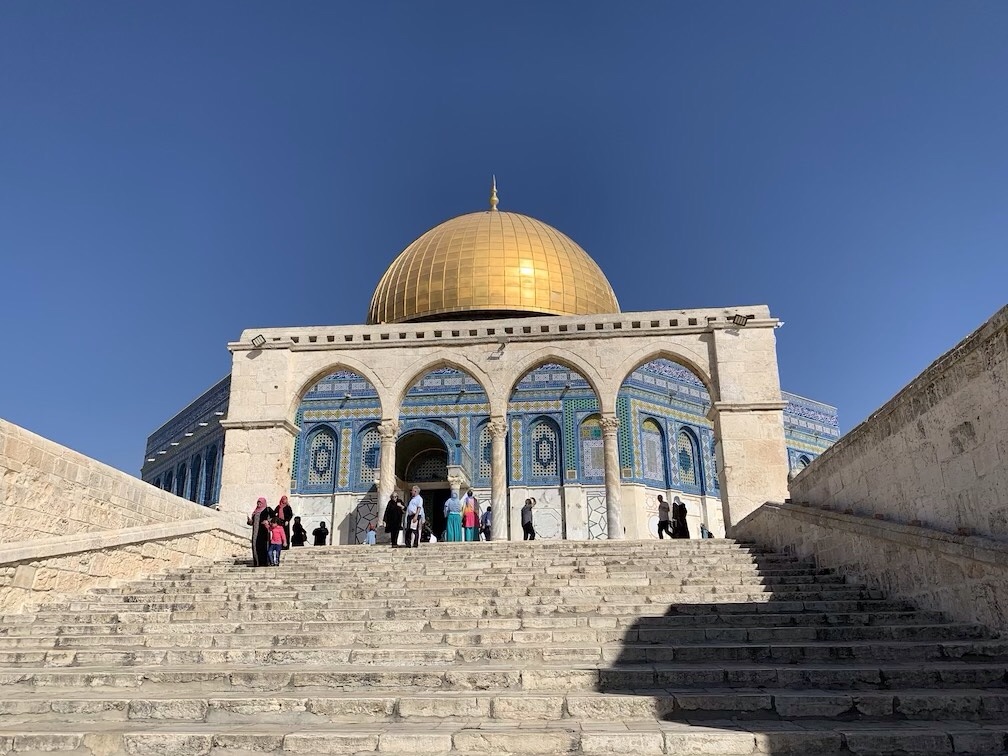
A considerable obstacle to the Jews rebuilding their temple in Jerusalem is the current presence of the Al-Aqsa Mosque and the Dome of the Rock, two of the holiest sites in Islam. Both structures are located on the Temple Mount (known as Haram al-Sharif in Islam), which is traditionally believed to be the location of the First and Second Jewish Temples.
Here are some specific challenges related to this:
- Religious Significance: The Al-Aqsa Mosque and the Dome of the Rock have been central to Islamic worship for over a millennium. Any attempt to alter or remove these structures would be met with strong resistance from the Muslim world.
- Political Implications: The status of Jerusalem, and particularly the Temple Mount/Haram al-Sharif, is one of the most contentious issues in the Israeli-Palestinian conflict. Any changes to the status quo could lead to significant political and social upheaval.
- Historical & Archaeological Concerns: While there is broad consensus among scholars and archaeologists that the Jewish Temples once stood on the Temple Mount, the exact locations and dimensions remain subjects of debate. Excavations or construction on the Mount would be controversial and potentially damaging to existing structures and artifacts.
- International Response: Any attempt to alter the status quo on the Temple Mount/Haram al-Sharif would likely elicit strong reactions from the international community, given the site’s significance to billions of people worldwide.
It’s worth noting that while there are some groups advocating for the rebuilding of the Jewish Temple, mainstream Jewish thought and Israeli policy have, for the most part, accepted the status quo, prioritizing peace and stability over any immediate plans to rebuild the Temple.
Holy Land
AD 324–640: Byzantine Period
With the conversion of the Roman emperor Constantine (AD 306–37), Christianity enjoyed a season of growth under the toleration championed by the Edict of Milan (AD 313). Constantine’s mother, Helena, began a vigorous campaign of building churches on locations in Israel associated with the life of Jesus. As pilgrims flocked to this land, some elected to remain and establish monastic communities. There was frequent destruction and rebuilding of Christian compounds during this era, much of it related to the Samaritan uprising (AD 529) and the Persian invasion (AD 614).
AD 640–1099: Early Arab (Islamic) Period
Byzantine rule, weakened by Persian invasion, collapsed quickly in the face of Arabian invaders who captured the city of Jerusalem in AD 638. Respectful of both Judaism and Christianity, these Muslim rulers protected and enhanced Jerusalem with new architecture that celebrated the city’s relationship to Islam. The Dome of the Rock was built in AD 691, and the El-Aqsa Mosque in AD 715. The exception to tolerance is linked to the rule of Caliph Hakim, who unleashed a persecution against Christians and their churches. During his rule, the tomb of Jesus at the Church of the Holy Sepulchre was destroyed (AD 1009).
AD 1099–1291: Crusader Period
At the close of the early Arab period, in his speech, Pope Urban II called for a military expedition to the Holy Land with the primary aim of recapturing Jerusalem from Muslim rule and protecting Christian. During the course of five Crusades, access was restored for European pilgrims, churches were rebuilt or founded, hospitals were established, and castles found their place on this land. Unfortunately the Crusaders also attacked and killed many Muslim and Jewish citizens of this land, imposing a negative image on the Crusades that lives to this day in the memory of many. By the close of the thirteenth century, the Crusaders had been defeated and driven from the promised land, largely because of the efforts of Saladin, the first sultan of Egypt and Syria.
 ABRAHAMIC THEOLOGY