
Azahari Hassim
Did John’s prophecy pertain to Jesus?
There is a debate among scholars regarding the interpretation of John the Baptist’s prophecy in Mark 1, verses 7 to 8. The passage mentions, “After me comes the one more powerful than I, the straps of whose sandals I am not worthy to stoop down and untie. I baptize you with water, but he will baptize you with the Holy Spirit.” Some argue that this prophecy may not necessarily be referring to Jesus.
This viewpoint is based on the observation that John the Baptist did not overtly follow Jesus as his disciple. John carried on with his ministry and was subsequently put in prison, separate from the ministry of Jesus.
Additionally, there was a dispute between John’s disciples and Jesus’ disciples over ceremonial washing (John 3, verse 25), and John even sent his disciples to ask Jesus, “Are you the one who is to come, or should we expect someone else?” (Matthew 11, verse 3; Luke 7, verse 19).
These actions suggest that John maintained an independent ministry and allowed room for questioning Jesus’ identity. Supporters of this viewpoint argue that if John truly believed Jesus was the one he prophesied about, he would have likely followed Jesus more devotedly.
Furthermore, they point out that the “one more powerful” could fit various Jewish eschatological figures such as the apocalyptic Messiah, a prophet like Moses, or the heavenly Son of Man.
In the context of Matthew 22, verses 41 to 45, a scholarly debate arises between Jesus and the Pharisees concerning the genealogy of the Messiah, who was not a direct descendant of David. This suggests that Jesus may have been referring to a person previously identified by John.
Supporters of this theory suggest that the person identified as John and Jesus could potentially be Muhammad, the revered prophet of Islam, instead of the anticipated Davidic Messiah.
There is a belief that Jesus was a messiah in the same sense as other messiahs before him. Scripturally, Jesus was not the apocalyptic messiah who was predicted by the Hebrew prophets to establish God’s kingdom in the Holy Land. Could you kindly provide an explanation for the meaning of the preceding statement?
The belief that Jesus was a messiah in the same sense as other messiahs before him refers to the idea that he was seen as a savior figure who would bring about spiritual redemption and salvation. In this context, messiah is understood as a leader or deliverer chosen by God to fulfill a specific role in the divine plan.
However, scripturally speaking, Jesus was not the apocalyptic messiah that many Jews were expecting based on the prophecies found in Hebrew scriptures. The traditional Jewish understanding of the apocalyptic messiah was of a powerful political and military leader who would liberate Israel from its enemies, establish God’s kingdom on earth in the Holy Land, and rebuild the Holy Temple in Jerusalem.
Jesus’ teachings and actions did not align with these expectations of a conquering warrior king. Instead, he preached about love, forgiveness, and spiritual transformation. He emphasized inner righteousness over outward displays of power. This led many Jews to reject Jesus as their expected messiah, that is, the apocalyptic messiah.
So, when it is said that Jesus was not the apocalyptic messiah predicted by Hebrew prophets to establish God’s kingdom in the Holy Land, it means that his role and mission were different from what many people at that time were anticipating based on their interpretation of scripture.
Does Islam represent the concept of “the Kingdom of God” as taught by Jesus and John the Baptist?
Did Jesus and John the Baptist announce the coming of the kingdom of God?
Yes, both Jesus and John the Baptist announced the coming of the Kingdom of God. John the Baptist’s ministry focused on repentance and emphasized the nearness of the Kingdom. John’s message in the Gospels urges individuals to repent and return to God, preparing for the arrival of the Messiah, referred to as the “son of man” in Jesus’ parables, who will establish the Kingdom.
Jesus continued this theme in His ministry, often speaking about the Kingdom of God in His teachings. He used parables, miracles, and sermons to explain the nature of this Kingdom, addressing its spiritual dimensions and moral implications.
Did Jesus equate the kingdom with the religion of Christianity?
No, Jesus did not explicitly equate the Kingdom of God with what later became known as Christianity. The term “Christianity” was not used during His lifetime; the followers of Jesus were initially seen as a Jewish sect.
In summary, Jesus and John the Baptist announced the coming of the Kingdom of God, but Jesus did not equate this Kingdom directly with the religion that later emerged as Christianity.
It is thought that Christianity originated as an apocalyptic group within Judaism, with Jesus proclaiming the arrival of the son of man and his Kingdom as described in the Book of Daniel. Islamic scholars believe that this apocalyptic figure, son of man, is none other than Muhammad who established Islam in the land where God promised to Abraham in Genesis 15, verse 18. Islam is regarded as the kingdom of God preached by Jesus. How is their argument articulated?
The argument by some Islamic scholars that the apocalyptic figure referred to by Jesus is Muhammad, and that Islam is the kingdom of God as preached by Jesus, is based on a reinterpretation of certain Biblical and Qur’anic texts. Here’s how the argument is articulated:
- Jesus and the Son of Man:
In Christian eschatology, the “Son of Man” is an apocalyptic figure described in the Book of Daniel and in the Gospels. Jesus speaks of the coming of the “Son of Man” who will establish God’s kingdom.
Islamic scholars who subscribe to this interpretation propose that the “Son of Man” could be a symbolic reference to Muhammad, who they argue, fulfilled this prophecy by establishing Islam from the River of Egypt to the Euphrates River including the Arabian Peninsula, a land promised to Abraham’s descendants. - The Kingdom of God:
In Christian theology, the “Kingdom of God” or “Kingdom of Heaven” is often understood as a spiritual realm where God reigns supreme, and which will be fully realized in the eschatological future.
Islamic scholars who support this view argue that Jesus’ references to the coming “Kingdom of God” were not about a spiritual kingdom, but a prophetic kingdom established on earth. They interpret this kingdom as the Islamic state that Muhammad established in Medina and later expanded throughout Arabia and beyond. - The Covenant and the Land Promise:
In Genesis 15, verse 18, God promises Abraham’s descendants a specific land. Jewish and Christian interpretations traditionally see this as a promise fulfilled in the biblical history of Israel.
However, some Islamic scholars reinterpret this promise in the context of Islam, suggesting that the true fulfillment of God’s covenant and the promised land is seen in the establishment of Islam from the River of Egypt to the Euphrates River, a promise made to Ishmael instead of Isaac. They argue that Islam, as the final and complete religion, fulfills this covenant. - Prophecies and Islamic Tradition:
Islamic tradition holds that Muhammad is the “Seal of the Prophets,” completing the line of prophets that includes Abraham, Moses, and Jesus. Some scholars interpret Jesus’ statements about a future prophet (like the “Comforter” in John 14, verses 16 to 17) as references to Muhammad.
They argue that Jesus was predicting Muhammad’s arrival, and that the establishment of Islam represents the realization of the kingdom Jesus spoke of. - Theological Implications:
This argument hinges on the belief that Islam is the final and most complete form of the Abrahamic faith, and that previous scriptures (Torah, Psalms, Gospels) were either incomplete or have been altered over time. The Qur’an is seen as the final, unaltered word of God, and Muhammad as the last prophet who brings the ultimate message.
In summary, the argument is built on a re-interpretation of Jesus’ teachings and the apocalyptic expectations found in the New Testament, suggesting that these were actually referring to the coming of Muhammad as a “son of man”and the establishment of Islam, which they view as the true “Kingdom of God.”
Holy Quran 3:39
Then the angels called to him (Zachariah) as he stood praying in the sanctuary: That Allah gives you the good news of John verifying a Word from Allah, and honorable and chaste and a prophet from among the good ones.
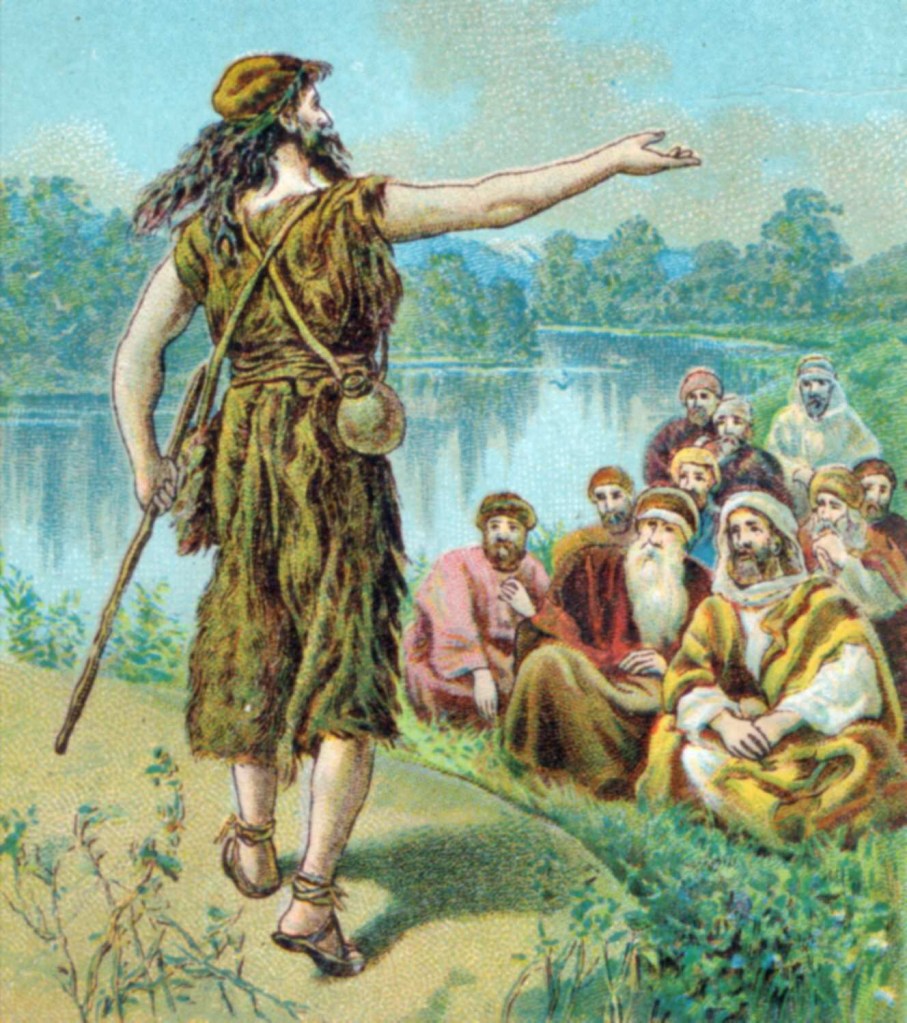
John the Baptist was an intriguing figure in the gospel narrative. Chosen by God, adopting a drastically different life, he was a voice in the wilderness.
John Baptist
Like Jesus, John the Baptist is born in miraculous circumstances. In Luke (1:5–23), an angel of the Lord visits Zechariah, an aged priest, and his barren wife Elizabeth. He announces that they will have a son and that he will become a great man of God. Such is Zechariah’s disbelief at this revelation—owing to their age— that God strikes him dumb. Zechariah recovers his speech when Elizabeth gives birth to their son, John. Luke confirms that the birth occurs just months prior to that of Jesus (1:36).
John becomes a preacher, living an austere and hermitic life in the desert. He preaches a message advocating both confession and repentance, and offers baptism in the River Jordan to all who heed him. John speaks, above all, of a “greater one” who will come after him—the Messiah prophesied in the scriptures. John’s preaching ultimately leads to his downfall, when he warns King Herod against marrying his brother’s wife. The king marries her anyway, but she never forgives John, and John is eventually beheaded on the whim of her daughter, Salome.
R.T. France – British New Testament scholar:
“John’s message of the kingdom of God is eschatological, calling for urgent repentance in light of an imminent divine intervention.”

Messianic hopes
The extravagant visions of the apocalypses were only one among the many hopes currently cherished by the Jews. Many messianic figures from the Old Testament had taken firm root in popular expectation: the prophet like Moses (Deuteronomy 18:15-19); the returning Elijah (Malachi 4:5-6); but above all the Son of David, a great king and warrior, whose mission it would be to bring victory, peace, and glory to Israel.
Some saw a place for the Gentiles in this hope, others were exclusively nationalistic. Some thought of spiritual restoration, most of victory over the Romans. To utter the word ‘Messiah’ (Greek, ‘Christ’) would inevitably stir up hopes of political independence, so it is no wonder that Jesus was cautious in letting others call him ‘Christ’. He came to a people who, if they were not agreed quite what they were hoping for, were united in eagerly ‘looking for the consolation of Israel’ (Luke 2:25). But none expected it to come by way of across.
 ABRAHAMIC THEOLOGY