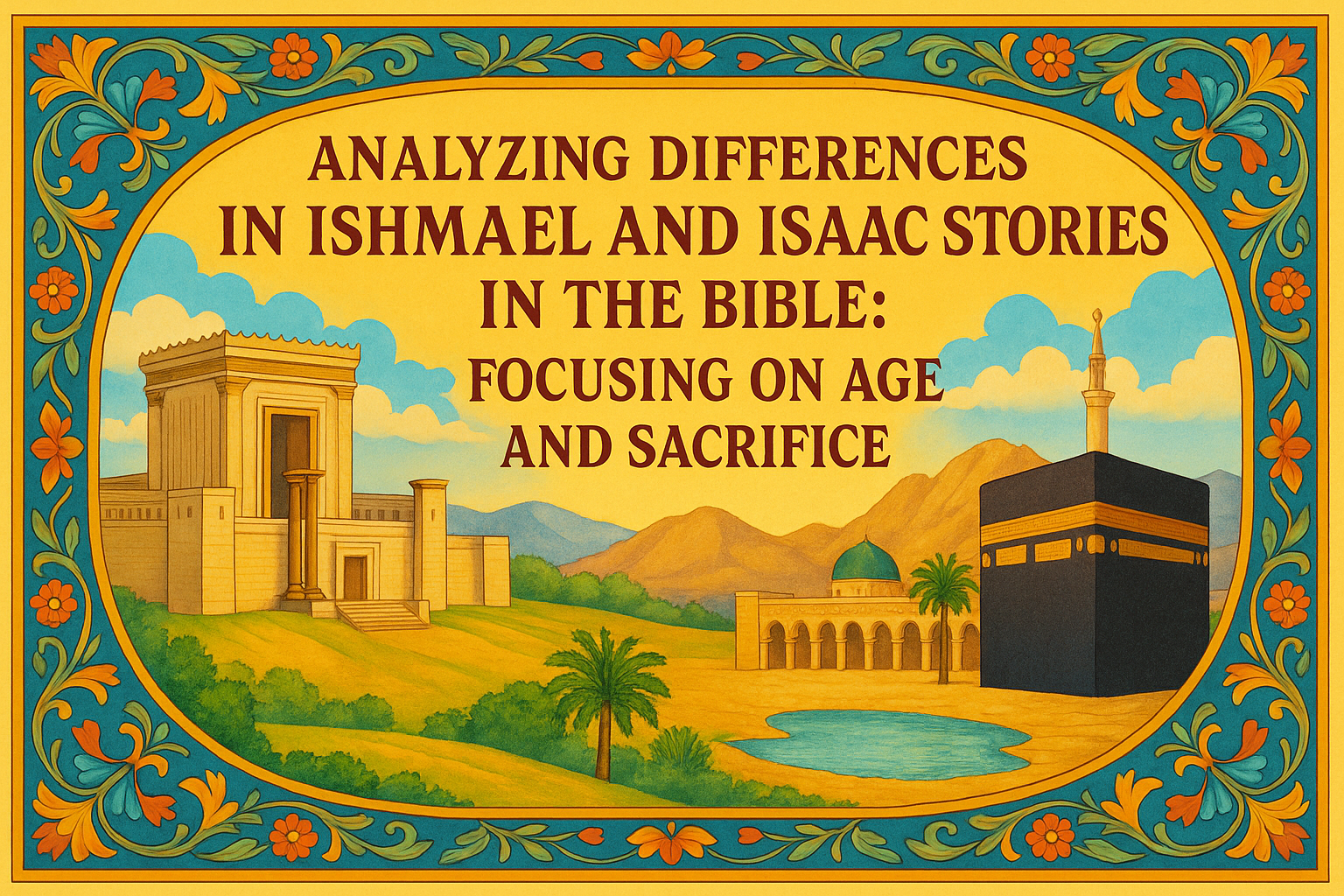
Azahari Hassim
Here is how the Jewish scribe manipulated Ishmael’s story:
- The age of Ishmael at the time of his departure from Abraham’s house.
- Abraham’s son, who was offered as a sacrifice.
Some people think that Ishmael, when sent away by Abraham in the Torah, was just a young child, not a teenager, based on the phrase “and he grew” in Genesis 21, verse 20. They point out that the Hebrew word “yelid” is used for both Ishmael and baby Moses (Exodus 2, verse 6). How do they explain this argument?
The argument is articulated by pointing out the use of the Hebrew word “yelid” in both Genesis 21, verses 14 to 15, and Exodus 2, verse 6. In these verses, “yelid” is used to describe both Ishmael and infant Moses. Supporters of the argument claim that since “yelid” is used to describe Moses when he was an infant, it should also be understood to mean that Ishmael was still a young child in Genesis 21, verse 20.
Additionally, the phrase “and he grew” in Genesis 21, verse 20, is interpreted by some to imply that Ishmael was still in the process of growing and developing, suggesting a younger age. They argue that if Ishmael were already a teenager or older, it would not be necessary to mention his growth.
It should be noted, however, that interpretations of biblical texts can vary, and different scholars or readers may have different understandings of the intended meaning.
Why are the statements about Abraham wanting to sacrifice his son in Genesis 22, verse 2, and verse 16 problematic? In one case, the son is referred to as “the only,” while in the other, the name of the son is not mentioned.
The story of Abraham being tested to sacrifice his son in Genesis 22 has raised some interpretative questions and concerns among readers. Specifically, the statements as mentioned in verses 2 and 16 are problematic for a couple of reasons.
First, in Genesis 22, verse 2, when God calls Abraham to sacrifice his son, Isaac is described as “your only son.” However, this raises a discrepancy because at that point, Abraham already had an older son named Ishmael, born to Hagar. Ishmael was not mentioned in this context, leading to confusion regarding why Isaac was referred to as the “only” son. This linguistic inconsistency has led some scholars to suggest that the story might have been composed independently from other narratives that mention Ishmael.
Secondly, in Genesis 22, verse 16, after Abraham successfully passes the test and God intervenes by providing a ram as a substitute sacrifice, God blesses Abraham and says, “because you have not withheld your son, your only son.” This repetition of “your only son” raises another concern since Isaac’s name is not mentioned. It seems that the narrative originally presents the unnamed and only son of Abraham, alluding to Ishmael who lived as Abraham’s only son for almost 14 years before Isaac was born.
These discrepancies may be due to several factors, such as different sources or traditions being woven together, intentional theological messaging, or even potential editorial modifications over time. Scholars have examined these issues and proposed various explanations to reconcile the inconsistencies, but it remains a topic of debate and interpretation.
Ultimately, the problematic nature of these statements arises from the textual and narrative intricacies within the story, which have led to questions about authorship, redaction, and theological implications.
RASHI’S COMMENTARY (Genesis 21:14)
and the child: (Gen. Rabbah 53:13) He also placed the child (Ishmael) on her shoulder, because Sarah had cast an evil eye upon him, and he was seized by a fever so that he could not walk on his feet.
Islamic Hajj as a reflection of alterations in the Torah
There is an argument among scholars regarding the significance of Hajj in Islam as a restored religion tracing back to Abraham. It is posited that Ishmael was exiled as a young child well before the birth of Isaac, and that Ishmael, rather than Isaac, was the intended sacrifice. How is this argument articulated?
The argument regarding the significance of Hajj in Islam as a restored religion tracing back to Abraham, and the associated narrative involving Ishmael and Isaac, is articulated through several key points:
- Lineage and Prophetic Tradition:
In Islamic tradition, Hajj is deeply connected to the figure of Abraham (Ibrahim). Muslims believe that Abraham, along with his son Ishmael (Ismail), played a foundational role in establishing the rites of Hajj. The Kaaba, the central structure around which Hajj is performed, is believed to have been built by Abraham and Ishmael. - The Story of Ishmael and Isaac:
Exile of Ishmael: According to Islamic narratives, long before Isaac was born, Ishmael and his mother Hagar were settled by Abraham in the desert of Mecca, which is where the Zamzam well miraculously appeared to sustain both of Hagar and her infant son Ishmael. This event is commemorated during the Hajj. The Sacrifice: Islamic tradition holds that it was Ishmael, not Isaac, who was the intended sacrifice. This is based on interpretations of the Quran, specifically Surah 37, verses 100 to 113, where it is generally understood that the son who was to be sacrificed was Ishmael. According to the sequence of events in the Quran, the promise of Isaac’s birth comes after the story of sacrifice, indicating that Ishmael is the son in question.
This contrasts with the Judeo-Christian tradition, which identifies Isaac as the intended sacrifice. - Symbolic Acts of Hajj: The rites of Hajj include reenactments and commemorations of events from the lives of Abraham, Hagar, and Ishmael. For instance:
The Sa’i, which involves walking seven times between the hills of Safa and Marwah, commemorates Hagar’s desperate search for water for her infant son Ishmael.
The stoning of the Jamarat represents Abraham’s rejection of Satan’s temptation, which is believed to have occurred when he was about to sacrifice Ishmael.
- Restoration of Abrahamic Monotheism:
Islam views itself as a continuation and restoration of the pure monotheistic faith of Abraham. The Hajj serves as a means to reconnect with the Abrahamic legacy, emphasizing monotheism, obedience to God, and the unity of the Muslim community.
In summary, the argument hinges on the belief that Ishmael, rather than Isaac, was central to the narrative of sacrifice and that the rites of Hajj are rooted in the events of Abraham’s life as they unfolded in Mecca with Ishmael. This perspective underscores the significance of Hajj in Islam and its connection to Abraham as a pivotal prophet in the monotheistic tradition.
The New Unger’s Bible Dictionary
ISH′MAEL
Age at the Time of the Expulsion.
The age of Ishmael at the time of his expulsion has given occasion to considerable discussion. He was doubtless thirteen years of age (Gen. 17:25) at the time of his circumcision, and the time of his expulsion was about two or three years later (21:5-8). The translation of 21:14, which seems to speak of Ishmael as an infant, is not an appropriate expression.
It is unnecessary to assume that the child was put on Hagar’s shoulder, the construction of the Hebrew not requiring it; and the sense of the passage rendering it highly improbable. Hagar carried “them,” i.e., the bread and the skin of water, on her shoulder. The fact of the lad’s being overcome by thirst and fatigue before his hardy Egyptian mother is not remarkable, especially when we remember God’s miraculous interposition in her behalf.
 ABRAHAMIC THEOLOGY