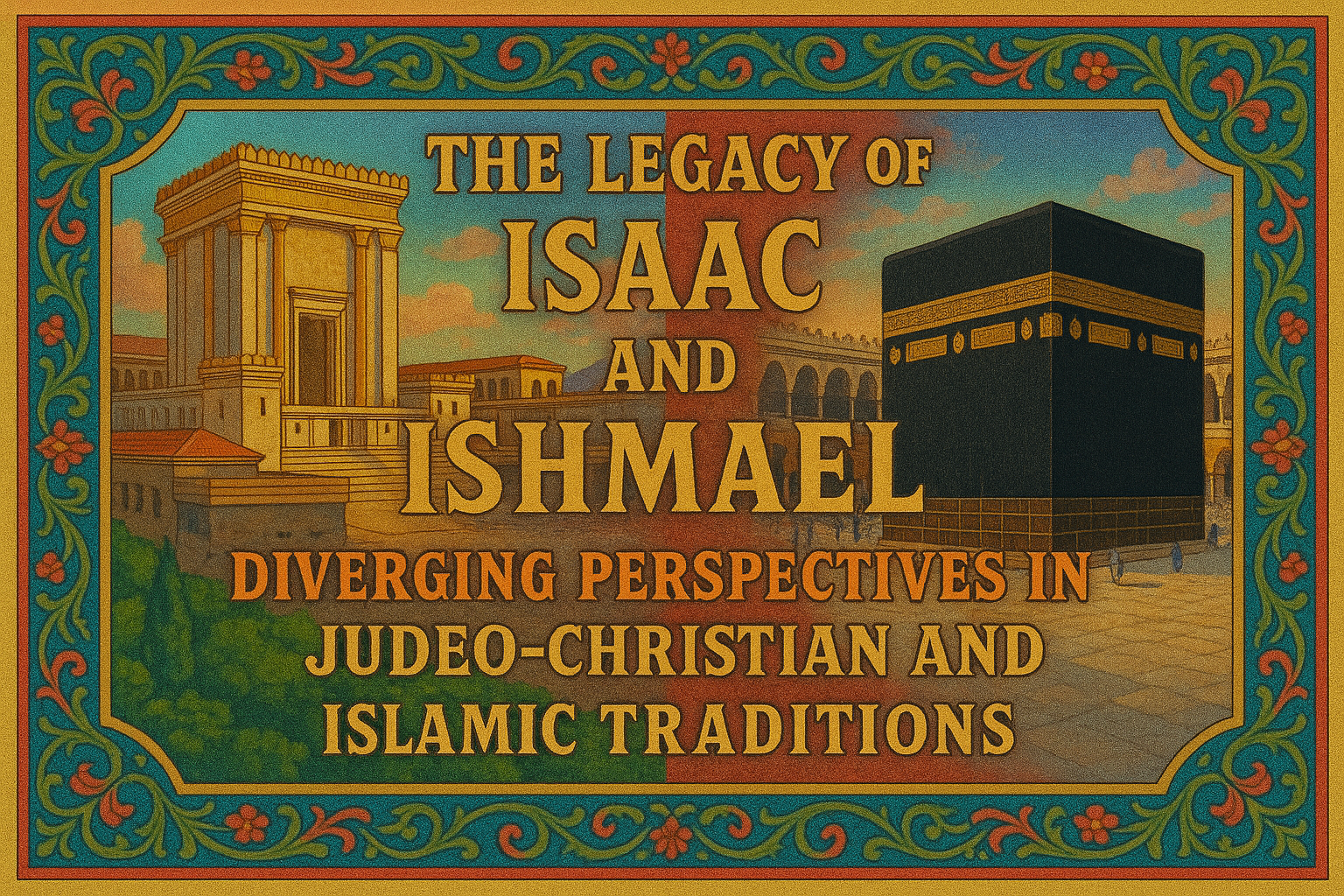
Azahari Hassim
What is the issue between Isaac and Ishmael from a Judeo-Christian perspective?
The issue between Isaac and Ishmael from a Judeo-Christian perspective stems from the story of Abraham and his two sons. According to the biblical narrative, Abraham and his wife Sarah were unable to have children, so Sarah gave her servant Hagar to Abraham in order to bear a child. Hagar bore Ishmael, but later Sarah miraculously gave birth to Isaac.
The tension between Isaac and Ishmael arises from the fact that both sons were considered heirs to Abraham, and their descendants became the ancestors of the Jewish and Arab peoples, respectively.
This has led to conflict and rivalry between the two groups throughout history. In the Bible, Ishmael and his mother Hagar were eventually sent away by Abraham at Sarah’s insistence, further exacerbating the animosity between the two sons and their descendants.
The issue between Isaac and Ishmael serves as a source of division and conflict within the Judeo-Christian tradition, often emblematic of the larger divides between the Jewish and Arab peoples. However, interpretations and understandings of this issue can vary among different religious and cultural contexts.
It is a common belief among Jews, Christians, and Muslims that God commanded Abraham to sacrifice his beloved son. However, these faiths differ on which son was to be sacrificed. Jews and Christians, drawing from the Old Testament, believe it was Isaac. In contrast, Muslims believe it was Ishmael.
In Genesis 22, verse 18 of the Torah, God tells Abraham,
“In your seed, all the nations of the earth shall be blessed, because you have obeyed my voice.”
Here, “seed” is interpreted by Jews to signify a great redeemer or divine messenger who will bring salvation to humanity. Christians share this view due to their inheritance of the Hebrew Bible.
Muslims, however, see Muhammad as the fulfillment of this promise, a view not shared by Jews and Christians. The Quran, in Surah 21, verse 107, states,
“And we have not sent you (Muhammad) but as a mercy to the worlds,”
reinforcing this belief. The Hajj, a central pillar of Islam, is considered a restoration of the religion of Abraham, which has been distorted by the Jews through their writings pertaining to whose son is to be sacrificed.
The Islamic narrative suggests that since Ishmael was Abraham’s only son for 14 years before Isaac’s birth, it is he who was to be sacrificed—a point hinted at in Genesis 22, verse 12, where God refers to Abraham’s “only son” without specifying a name. Muslims see this ambiguity as indicating Ishmael, rather than Isaac.
Circumcision is another point of contention. It is a practice traced back to Abraham and mandated in the Torah. Christians, however, have largely abandoned physical circumcision, instead emphasizing spiritual circumcision, or placing one’s faith in Jesus Christ. The Quran does not explicitly mention circumcision, but Surah 16, verse 123, which instructs Muhammad to follow the religion of Abraham, is interpreted by some to imply the practice. Thus, circumcision is widely regarded as obligatory in Islam.
Controversy arose in the early church (Acts 10-15) as to whether Gentile converts need be circumcised. Paul led the Jerusalem Council to decide circumcision was not essential to Christian faith and fellowship. Circumcision of the heart via repentance and faith were the only requirements.
The article questions why the Torah does not require the Israelites to commemorate Abraham’s sacrifice, as it does with other significant events like Passover. It suggests that this absence supports the Islamic claim that it was Ishmael, not Isaac, who was nearly sacrificed.
Furthermore, it argues that the practice of circumcision, which renders a sacrifice blemished according to Deuteronomy 17, verse 1, would disqualify both Isaac and Jesus as perfect offerings.
Since the scripture forbids sacrificing animals with defects, it’s argued that this applies to the child meant for offering. Isaac’s circumcision on the eighth day, alongside Jesus’s, is seen as scripturally imperfect for such a sacrifice.
In conclusion, the article implies that the religious practices of Jews and Christians have deviated from what it claims to be the original Abrahamic faith, particularly concerning the Sacrifice of Abraham and the rite of Circumcision.

Two covenants: Abrahamic and Sinai covenants from an Islamic perspective
Genesis 49, verse 10, reads:
“The sceptre shall not depart from Judah, nor a lawgiver from between his feet, until Shiloh come; and unto him shall the gathering of the people be.”
The verse implies that Judah’s offspring will govern Israel until the arrival of “Shiloh,” who holds all royal power. Here, Shiloh, similar to “the Seed” in Genesis 22, verse 18, refers to the future Messiah.
From an Islamic perspective, the word “Shiloh” in Genesis 49, verse 10, is connected to the Abrahamic covenant through Ishmael, who, not Isaac, is believed to be nearly sacrificed. Conversely, the terms “scepter” and “lawgiver” mentioned in Genesis 49, verse 10, are associated with the Sinai covenant. How is their argument articulated?
From an Islamic perspective, the interpretation of Genesis 49, verse 10, and its connection to the Abrahamic covenant through Ishmael involves several key arguments:
- Shiloh as Muhammad:
Some Islamic scholars interpret “Shiloh” as a reference to Prophet Muhammad. They argue that the prophecy indicates a shift in divine authority away from the line of Judah to a descendant of Ishmael. - Abrahamic Covenant through Ishmael:
Islamic tradition holds that it was Ishmael, not Isaac, who was nearly sacrificed by Abraham. This is seen as a pivotal moment in the Abrahamic covenant, establishing Ishmael’s line as the inheritors of God’s promise. - Scepter and Lawgiver:
The terms “scepter” and “lawgiver” in Genesis 49, verse 10, are associated with the Sinai covenant given to Moses. Islamic interpretation suggests that these symbols of authority and divine law would remain with the descendants of Judah until the coming of “Shiloh” (Muhammad). - Transfer of Authority:
The verse is interpreted to mean that the religious and political authority (“scepter” and “lawgiver”) would depart from Judah’s line when Shiloh (Muhammad) comes. This is seen as a prophecy of the transition of divine guidance from the Israelite tradition to Islam. - Gathering of the People:
The phrase “unto him shall the gathering of the people be” is interpreted as referring to the universal message of Islam brought by Muhammad, which would unite people from various nations and backgrounds. - Continuation of Abrahamic Legacy:
Islamic scholars argue that Muhammad, as a descendant of Ishmael, fulfills this prophecy by bringing the final revelation that completes and supersedes previous covenants, while still maintaining continuity with the Abrahamic tradition. - Non-Judahite Messiah:
Some interpretations suggest that the verse implies the coming of a messianic figure from outside the tribe of Judah, which aligns with the Islamic view of Muhammad’s lineage through Ishmael.
It’s important to note that this interpretation is specific to Islamic theology and is not accepted in Jewish or Christian exegesis. The Islamic perspective sees this verse as one of many biblical passages that they believe foretell the coming of Prophet Muhammad and the establishment of Islam as the final Abrahamic faith.
Hajj’s Importance in Islam: Reconnecting with the Abrahamic Legacy Through the Story of Ishmael
There is an argument among scholars regarding the significance of Hajj in Islam as a restored religion tracing back to Abraham. It is posited that Ishmael was exiled as a young child well before the birth of Isaac, and that Ishmael, rather than Isaac, was the intended sacrifice. How is this argument articulated?
The argument regarding the significance of Hajj in Islam as a restored religion tracing back to Abraham, and the associated narrative involving Ishmael and Isaac, is articulated through several key points:
1. Lineage and Prophetic Tradition:
In Islamic tradition, Hajj is deeply connected to the figure of Abraham (Ibrahim). Muslims believe that Abraham, along with his son Ishmael (Ismail), played a foundational role in establishing the rites of Hajj. The Kaaba, the central structure around which Hajj is performed, is believed to have been built by Abraham and Ishmael.
2. The Story of Ishmael and Isaac:
Exile of Ishmael: According to Islamic narratives, long before Isaac was born, Ishmael and his mother Hagar were settled by Abraham in the desert of Mecca, which is where the Zamzam well miraculously appeared to sustain both of Hagar and her infant son Ishmael. This event is commemorated during the Hajj.
The Sacrifice: Islamic tradition holds that it was Ishmael, not Isaac, who was the intended sacrifice. This is based on interpretations of the Quran, specifically Surah 37, verses 100 to 113, where it is generally understood that the son who was to be sacrificed was Ishmael. According to the sequence of events in the Quran, the promise of Isaac’s birth comes after the story of sacrifice, indicating that Ishmael is the son in question. This contrasts with the Judeo-Christian tradition, which identifies Isaac as the intended sacrifice.
3. Symbolic Acts of Hajj:
The rites of Hajj include reenactments and commemorations of events from the lives of Abraham, Hagar, and Ishmael. For instance:
The Sa’i, which involves walking seven times between the hills of Safa and Marwah, commemorates Hagar’s desperate search for water for her infant son Ishmael.
The stoning of the Jamarat represents Abraham’s rejection of Satan’s temptation, which is believed to have occurred when he was about to sacrifice Ishmael.
4. Restoration of Abrahamic Monotheism:
Islam views itself as a continuation and restoration of the pure monotheistic faith of Abraham. The Hajj serves as a means to reconnect with the Abrahamic legacy, emphasizing monotheism, obedience to God, and the unity of the Muslim community.
In summary, the argument hinges on the belief that Ishmael, rather than Isaac, was central to the narrative of sacrifice and that the rites of Hajj are rooted in the events of Abraham’s life as they unfolded in Mecca with Ishmael. This perspective underscores the significance of Hajj in Islam and its connection to Abraham as a pivotal prophet in the monotheistic tradition.

How is Ishmael depicted in the Midrash literature?
According to Midrashic literature, there are several positive portrayals of Ishmael, Abraham’s eldest son:
In Pirkei deRabbi Eliezer, an 8th century midrashic work, Abraham visits Ishmael twice after sending him away. In the first visit, Ishmael’s wife refuses to give Abraham food and water. Ishmael then divorces her and marries a woman named Fatimah. On Abraham’s second visit, Fatimah shows him hospitality. The midrash states that “Abraham stood and prayed before the Holy One, blessed be He, and Ishmael’s house became filled with all good things. When Ishmael returned, his wife told him about it, and Ishmael knew that his father still loved him.” This portrays a reconciliation between Abraham and Ishmael.
The name of Ishmael’s second wife, Fatimah, is significant as it is the name of Muhammad’s daughter in Islam. Pirkei deRabbi Eliezer, by using this name, is making a positive reference to Islam, indicating the possibility of friendship between the two Abrahamic faiths descending from Isaac and Ishmael.
In another midrash, Abraham again visits Ishmael and encounters his kind wife Fatimah, who provides him food and drink. Abraham prays for Ishmael and his house is blessed. When Ishmael returns, he realizes his father’s love and compassion for him remain, as it says “Like a father has compassion for his children” (Psalms 103:13).
Some of the greatest Talmudic sages and high priests were named Ishmael, showing he was considered righteous, even though Isaac was chosen to carry on Abraham’s legacy. The biblical narrative only hints at Ishmael’s story, but the Midrash expands on it, ultimately portraying Ishmael as repenting and being righteous.
In summary, while Isaac was destined to father the Israelites, the Midrash contains several stories painting Ishmael in a positive light – as ultimately reconciling with Abraham, being blessed by his father’s prayers, and having his line produce righteous individuals. The Midrash sees the potential for friendship between Isaac and Ishmael’s descendants.
 ABRAHAMIC THEOLOGY